Florian Gallenberger in Interview: “Giving the Audience an Emotional Experience.”
· 5 min read
Florian Gallenberger received his Oscar for his short film “Quiero ser” while still a film student. For his feature film debut “Schatten der Zeit”, the director dared to go straight to India. With the epic “John Rabe” in 2009, he told the true story of the “Schindler of China” with Ulrich Tukur and Daniel Brühl in the leading roles. Brühl now once again takes on the lead role, this time alongside Emma Watson, in “Colonia Dignidad”.
As fictional heroes, the two end up in the notorious camp of cult leader Paul Schäfer, who, during the military coup in Chile, collaborated with dictator Pinochet and was also supported by the German embassy. The political thriller had its European premiere at the Zurich Film Festival. There, [030] contributor Dieter Oßwald spoke to the director.
Mr Gallenberger, was the early Oscar a curse or a blessing?
GallenbergerOf course, something like that is always a bit of a double-edged sword because there is a certain pressure and expectation, which in weaker moments can rub off on you and make you worry a lot. The expectations are there, but whether one lets oneself be affected by them or not is a decision in itself. I make my films as well as I can. If audiences like them, I’m very pleased. But I can’t spend all my time paranoically obsessing over this Oscar.
Florian GallenbergerWhy is it that the thriller genre is so rarely used for cinema in this country?
GallenbergerOn the one hand, it has to do with the fact that crime dramas are so strong on television. ‘Tatort’ regularly attracts 10 million viewers, so many probably think there’s no need to go to the cinema for that sort of story. However, there have always been powerful German thrillers that have also been successful — especially those dealing with true events, like “Die Welle”, “The Baader Meinhof Complex” or “The Experiment”.
Would you see “Colonia Dignidad” in the tradition of “Missing”?
Gallenberger“Missing” is a great work of film history, so I wouldn’t want to directly compare myself. While its focus was on depicting the political context of a country, in our case the two heroes find themselves completely unprepared in this hell called Colonia Dignidad. Our film doesn’t set out to explain or analyse, but rather to give viewers an emotional experience that is hopefully intense. And if people are interested in the historical context, they’ll go and Google it afterwards.
The German embassy does not exactly cover itself in glory in this scandalous tale of torture and abduction…
GallenbergerThe German embassy worked closely with Colonia Dignidad right up until 1985. The few people who managed to escape the camp had to go to the embassy because they didn’t have passports — and were then sent back! Even today, Colonia Dignidad remains a hot potato in diplomatic circles, one nobody wants to touch. I think the Foreign Office’s role at the time really should be thoroughly investigated.
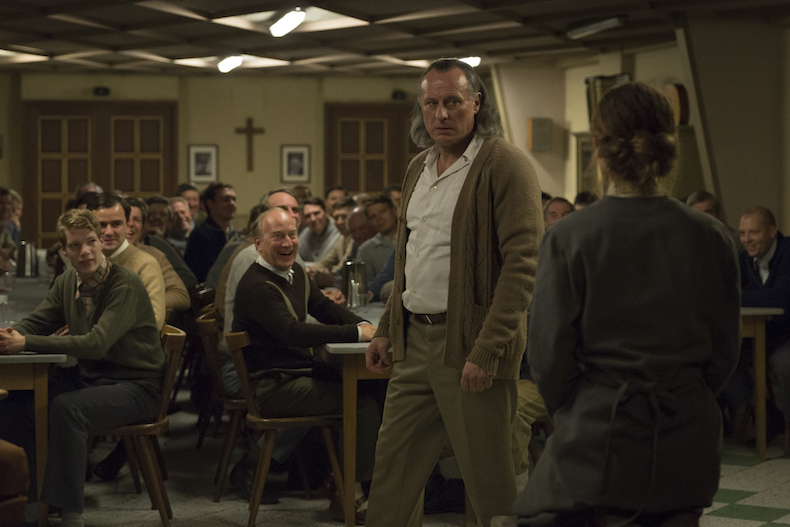
Lena (Emma Watson) is humiliated at the gathering of men by Paul Schäfer (Michael Nyqvist).
Do you want your film to bring about a re-examination of this chapter of history?
GallenbergerWhat’s important to me is that “Colonia Dignidad” as a mainstream thriller reaches as broad an audience as possible. If that succeeds, the film will also ensure that the incidents of the past are no longer just swept under the carpet, to fade into the sands of history and be entirely forgotten.
Some of the perpetrators now live in Germany…
GallenbergerThe doctor who was responsible for many crimes in Colonia was legally convicted in Chile, but escaped his prison sentence by fleeing to Germany. He now lives in Krefeld and the authorities here seem completely uninterested.
How authentic is the film?
GallenbergerThe two main characters played by Emma Watson and Daniel Brühl are fictional, but their entire environment is based on real events. From the military’s selection process in the stadium in Santiago to Paul Schäfer’s death-and-rebirth sessions in the community. Even Schäfer’s remarks during these sessions are documented and now appear as dialogue in the film.
How difficult is it to restage events from Colonia for a feature film?
GallenbergerThe film is, above all, very suspenseful and is ultimately entertainment. But during research I often visited the original scenes of daily horror, places that really do give one a claustrophobic, haunted feeling. When staging these scenes later, that memory is always there.
It’s almost become Daniel Brühl’s trademark to have a nude scene in every film — does he get that put into his contract in advance?
Gallenberger(Laughs) No, that’s a funny rumour, but there’s absolutely nothing to it! I wrote the main character, Daniel, with him in mind. For me, he brings exactly the right mixture of sensitivity, openness and masculinity that I envisaged for this role.
You shot with Brühl seven years ago — how has he changed?
GallenbergerDaniel was always a very good actor in my view, and he’s now become even better. The moment the camera rolls, something just clicks for him. He conveys great intensity and an enormous sense of authenticity, seemingly without effort. Daniel is incredibly precise and reliable. He brings a lot to his role and is a real asset to the film, never letting his director down.
Where do you keep your Oscar?
GallenbergerOn the bookshelf in my living room. Quite normal, really…