“ICONIC” in DRIVE Berlin: Iconic travel from yesterday to today
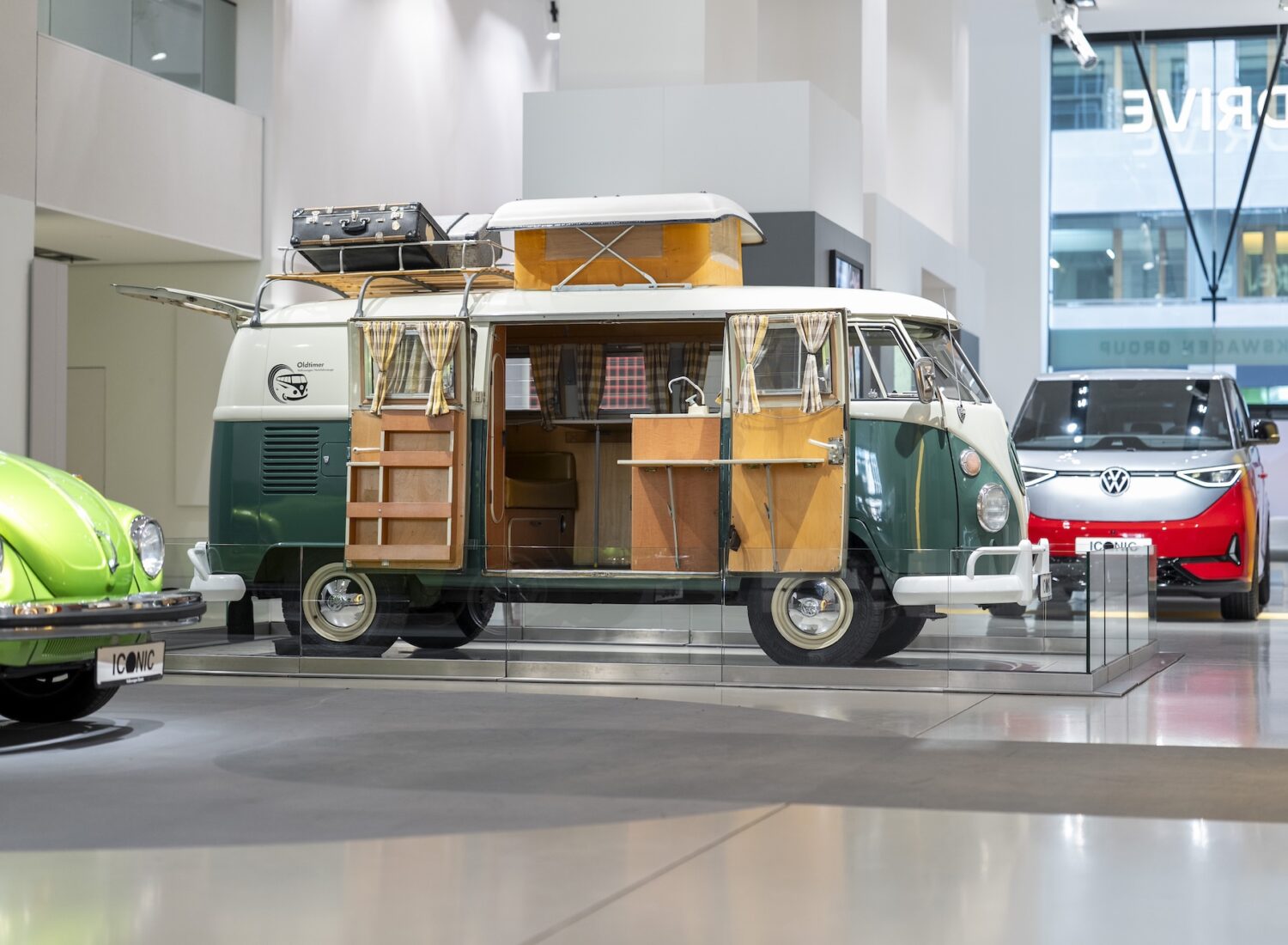
Outside, the Berlin rush hour traffic flows through Friedrichstraße. People with coffee-to-go cups walk past shop windows, subways disappear under the asphalt, somewhere a delivery truck honks. Inside the DRIVE. Volkswagen Group Forum On the other hand, an old Bulli stands like a frozen summer moment. A few scratches in the paint, thin steering wheel, curtains behind the windows. Images immediately come to mind: Atlantic coast. Coffee break at a rest stop. Arguments over maps. Sunsets on camping chairs. And suddenly you understand what the exhibition “ICONIC – A Timeless Journey of Culture, Society and Mobility” is actually about. Not about cars. But about memories.
With the new theme world “Iconic Travel,” the DRIVE in Berlin-Mitte is expanding its exhibition, which has been running since 2024, by exactly that emotional level that often makes mobility significant: longing, freedom, and the question of why certain journeys remain in one’s life forever. Over 1.1 million visitors have seen the exhibition so far. And it quickly becomes clear why. “ICONIC” works less like a classic museum than much more like a cultural resonance room between design, society, music, architecture, and collective memory.
The longing for being on the road

It is particularly strong there, where the exhibition connects historical travel culture with today’s forms of being on the road. Old photographs show families driving the Volkswagen Beetle across the Alps towards Italy in the 1950s. Pictures full of improvised freedom. Full roofs, dusty streets, people who could finally just get on the road for the first time. Not luxurious. Not perfectly organized. But with this feeling that something new might begin behind the next bend. These early journeys stand today almost symbolically for a time when mobility suddenly created possibilities. One’s own car became a promise of self-determination. That is precisely why vehicles like the Beetle or the Bulli are long since more than means of transport. They have become cultural icons. It is interesting that this feeling has persisted to this day – although travel has completely changed. Today, people sleep in converted vans on Portuguese coastlines, drive for days to festivals like Wacken, or look for a form of deceleration on country roads that everyday life hardly allows anymore. This present is also addressed by the exhibition. Festival trips are not treated as a side issue here, but understood as modern pilgrimages: collective movement, community, escapism. The journey becomes part of the experience.
Maria Ehrich and the freedom of slow travel
It hardly surprises that this longing for slowness has become so strong again. Perhaps because travel has become often more efficient than ever before – and at the same time emotionally emptier. Airports look the same everywhere. Navigation replaces orientation. Everything is immediately available. Maria Ehrich describes this tension field in interviews about her world trip with an old VW Beetle. Together with her partner Manuel Vering, she drove through different countries for months – not as fast as possible, but deliberately slowly. In conversations about the trip, Ehrich repeatedly talks about how precisely the imperfect makes up the real value of being on the road. That you meet people differently when you have time. That uncertainty often connects more intensely than comfort. In a way, she once formulated that slow travel changes the way you look: you suddenly no longer just see places, but begin to perceive moods. Sounds, smells, encounters. Small moments that would have long disappeared in a plane window. Her book about the trip also repeatedly revolves around this thought. It is not the spectacular destinations that are at the center, but the in-between. Potholes. Detours. Conversations at gas stations. The feeling of giving up control for a while. That is precisely why Ehrich fits surprisingly well into this exhibition. Because her trip does not feel like an influencer project, but like the modern continuation of that old Beetle romance that already tells the historical photographs in the DRIVE.
Memories on 4 wheels
The exhibition of this bridge between the past and the present is particularly impressive with an exhibit that stands almost casually in the room and yet attracts all attention: “Irene”, a historical Volkswagen Type 2 Westfalia camper van. Not a sterile collector’s object behind glass, but rather a rolling memory capsule. You look inside and automatically think of rainy camping sites, coffee on a gas stove in the morning and this strange luxury of simply having time. Right next to it stands the futuristic present of the same idea with the ID. Buzz. Digital, quieter, cleaner. And yet this vehicle is still based on the same cultural longing: to be on the road without being completely fixed. However, the interactive “ICONIC Destination” map is almost even more exciting. Visitors mark places that have become personally iconic for them. Some points stand for long trips, others only for a lake in Brandenburg or a rest stop somewhere in southern France. That is precisely the real strength of the exhibition: it does not explain iconic travel as elitist. But as something deeply personal.
Why things work differently when you really want them to
Perhaps that’s why “ICONIC” is resonating with people right now, because our relationship with mobility is changing. For a long time, traveling was primarily seen as a matter of speed and efficiency. Today, it seems to have become more important for many people to feel something again. To perceive the path. To allow detours. To not be permanently accessible. The exhibition at DRIVE Berlin understands this surprisingly well. It doesn’t romanticize mobility blindly, but rather shows it as part of our cultural identity. Between longing and memory. Between embarking and being overwhelmed. Between analog past and digital present. And while cars continue to roll over Unter den Linden outside, inside, for a brief moment, this feeling lingers, which probably makes every good trip: the feeling that something unexpected may still be waiting around the next corner.
“Iconic Travel” as part of the “ICONS” exhibition
Where? @ DRIVE.Volkswagen Group Forum.
Address: Friedrichstraße 84, 10117 Berlin
Admission is free.