
“The Real Film Exists in the Viewer’s Mind.” | Sebastian Schipper in Interview
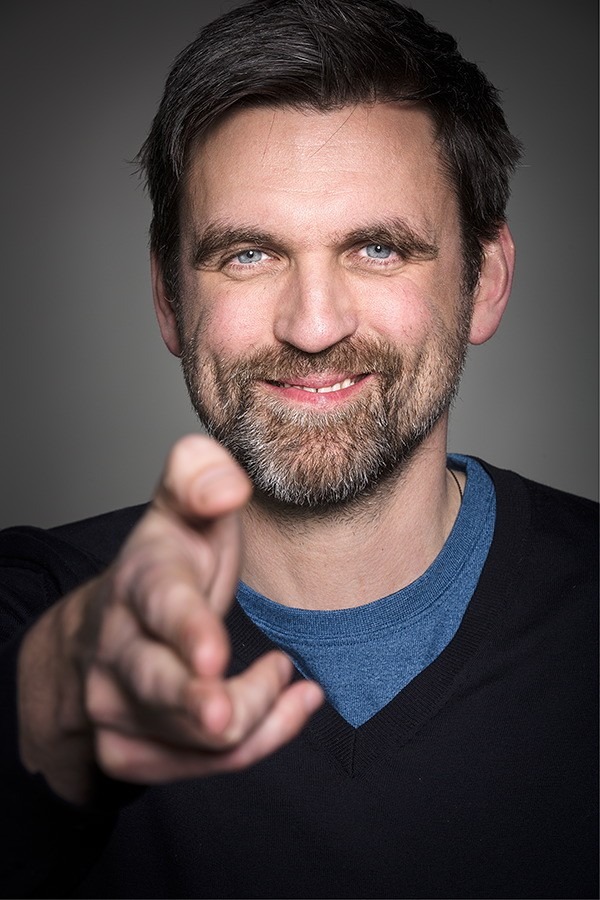
A feature film without a single cut – that had never been done before. Sebastian Schipper, 51, dared to try the crazy experiment with the Berlin crime drama “Victoria” and was celebrated for the coup at the Berlinale. Schipper had already caused a stir in 1999 with his debut “Absolute Giganten”. He followed up with another buddy film, “A Friend of Mine”, starring Daniel Brühl and Jürgen Vogel. Schipper also played Detective Katz alongside Wotan Wilke Möhring in “Tatort” on four occasions. Additionally, he regularly appears in films by Tom Tykwer.
Now, with “Roads”, he presents the story of a friendship between two teenagers who travel from Morocco to Europe in a camper van. Our contributor Dieter Oßwald spoke with the director.
Mr Schipper, your film claims that hugs need to last 20 seconds for hormones to be released. Is that just a pretty invention or the truth?
Schipper: The idea came from our actor Ben Chaplin, who plays the father in the film. He made that claim about hugging and I spontaneously used it for the film. Whether it works, anyone is welcome to try it out for themselves! (Laughs)
“Roads” tells the story of a friendship between a young Briton and an African as they travel from Morocco to Calais. To what extent do you see this as a refugee film?
Schipper: I didn’t want to make a film about refugees. “Roads” is set in the Europe of migration, yet we didn’t make a social drama or a problem film. Refugees are simply a reality that my main characters can’t avoid. But above all I made a film about two eighteen-year-olds. One just happens to be from London, the other from the Congo. That’s really the first sentence about this film. All the others come after.

The beginning of a wonderful friendship unfolds in an unusually understated manner – why is that?
Schipper: The two young heroes aren’t friends right from the start; the crucial thing is that they simply spend a lot of time together. This leads to moments where they tell each other about their lives, where they laugh or argue together. And then there are those moments when they just sit next to each other in the camper van, not saying much at all.
How important are such gaps in the narrative? Do you want the viewer to assemble the mosaic for themselves rather than everything being spoon-fed?
Schipper: The real film is created in the viewer’s mind, that’s how cinema works. What it’s really about happens between the images.
The friends are challenged by a rather bizarre hippie, played by Moritz Bleibtreu. How do you get big stars to take on small roles?
Schipper: In every one of my films, there’s always been a moment when I wondered whether I should do it with Moritz Bleibtreu. Sadly, it never happened until now. So it made me all the happier that this fantastic actor was keen on this little, madcap part. We both had a lot of fun with it.
The atmosphere in the Calais refugee camp seems less enjoyable. How were you received there?
Schipper: The Mayoress of Calais didn’t grant us filming permission, as she was concerned about its image as an attractive holiday destination. The volunteers, on the other hand, supported us and allowed us to film in their warehouse where donated clothes are sorted. All other scenes set in Calais were recreated elsewhere. The refugees were also played by extras, since many of the migrants do not have papers. And our filming was very closely monitored by the authorities.
With “Victoria”, you completely did away with editing; this time, you spent plenty of time in the editing suite. Did you feel the need to catch up on that?
Schipper: I actually enjoyed my time in the editing room, not least because I had a wonderful editor. We edited the film itself very quickly. However, when we found the right music, we took extra time to find the right rhythm between sound and images.
With “Victoria”, you won six Lolas and a Silver Bear. Does that ramp up the pressure of expectation for the next project?
Schipper: When you’re making films, you want to create something special and you have to keep realising just how hard it is to make a surprising, believable and emotional film. It’s crazy how complex, profound, almost alchemical filmmaking is. With a bigger budget and several partners, all expecting something, there is more pressure – but your own hopes are always the greatest pressure of all.
Do you share the enthusiasm that Amazon, Netflix and the like are opening up entirely new opportunities for auteur filmmakers? Or is it nothing but a bubble?
Schipper: My first film, “Absolute Giganten”, only did average business at the cinema but was much more successful on DVD. Similarly, “Victoria” only had a small cinema release in the USA. When it appeared on Netflix there, it was, as far as I know, incredibly popular. At that time, things were much wilder among the streaming services. There used to be a rating system in which viewers could give stars. These days the more unusual films are much harder to find there.
After the success of “Victoria”, many expected the premiere of “Roads” there as well. Why didn’t that happen? Did you neglect to hug Berlinale director Dieter Kosslick for 20 seconds?
Schipper: You’ll have to ask Dieter that. I’m looking forward to the Berlinale’s glorious future.
ROADS opens in cinemas on 30 May.
Photo: © Gerhard Kassner / Berlinale