Scandinavia by camper van and folding bike: Small when folded, built to go far
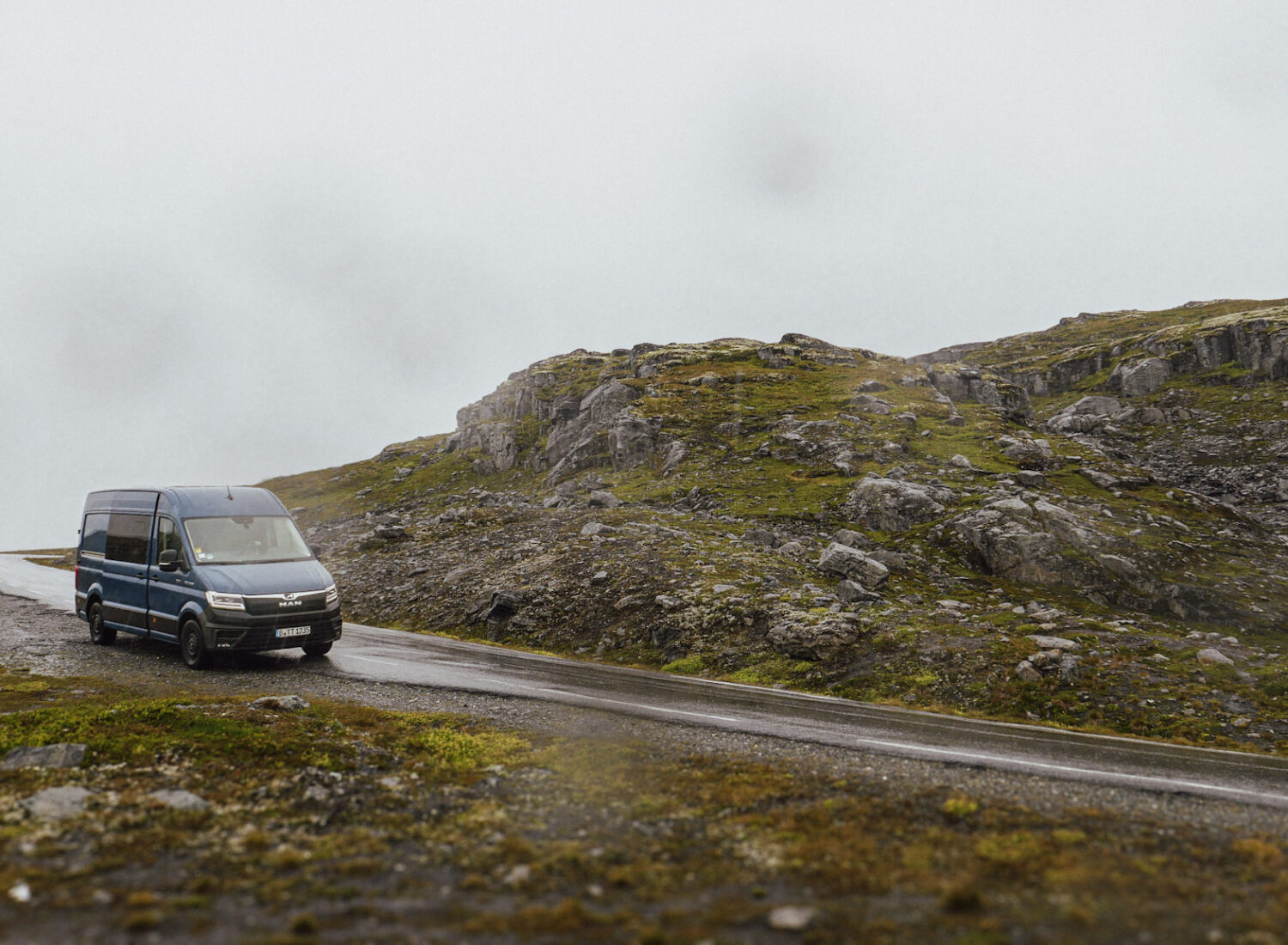
Once with the camper through Scandinavia: Norway from south to north, continuing through Finland and across Sweden back. About 7,000 kilometers of road, fjords, mountains, ferries and a lot of scenery. On board: a Brompton Electric P Line with e-Motiq drive. Designed as a practical auxiliary boat for the camper. In the end, it was one of the most used equipment parts of the trip.
There is a simple rule for longer camper trips: everything you bring must justify its place. After at least a week, you know pretty exactly which things are really useful and which ones you’ve been dragging around half Europe for completely useless reasons since Berlin. Before leaving on the Brompton, I wasn’t quite sure which category it would fall into. An electric folding bike? Of course, sounds practical. But do I really need that when there’s a camper parked right next to me? After a few days in Norway, the question was answered. Yes. And surprisingly often.
The dinghy for the camper
Our plan was somewhat ambitious: Norway from the south to far into the north, then through. Finland and over Sweden back towards home. A classic road trip, then – just quite large. The camper van is of course perfect for this. Kitchen, bed and home just come along. However, it has a decisive disadvantage: it is large. You will notice this at the latest when you have to leave the parking space again for a liter of milk. Or when the city center is three kilometers away. Or when you are parked in a nice place and wonder what is really coming around the next bay. That is exactly where the Brompton began its job. Rear door open. Wheel out. Fold up. Go. The famous Brompton folding system is no nice toy on the road, but the real highlight of the bike. Folding together, our Electric P Line Just about 64.5 × 60 × 32 centimeters. There is no need for a bicycle rack and no fixed parking space outside the vehicle. Above all, it is not permanently in the rain and street dirt. And there is quite a bit of both in Norway.
16 kilograms instead of bicycle carrier
Our Electric P Line weighs around 16 kilograms. If you remove the battery, you are left with about 12.5 kilograms. For a full-fledged e-bike, this is remarkably little. You can notice this in everyday camper life. A classic e-bike quickly weighs well over 20 kilograms. Two of them practically automatically require a stable bicycle carrier. The Brompton, on the other hand, simply disappears in the vehicle. And if you don’t want to carry it, there is SuperRoll+ Into play. In its folded state, the bike can be moved on its small wheels. At first glance, this sounds like one of those product features that seem more important in a brochure than in real life. Until you roll the bike over a campsite, a parking lot, or through a hotel lobby for the first time. Then you understand it. The bike turns into a kind of rolling suitcase in just a few seconds.
Unfortunately, Norway has mountains
Now you could argue that you could do the same with a normal Brompton. True. Until the road goes up. And in Norway it goes up quite often. I like to ride a bike. However, my enthusiasm for voluntarily tramping up a Norwegian mountain after a long day of riding is manageable.
That is exactly why the electric drive made a greater difference on this trip than I had expected.
Bromptons new works in the Electric P Line e-Motiq system. The 250-watt rear wheel motor delivers up to 24 Nm of torque. On paper, this doesn’t sound spectacular compared to some mature e-bikes. On the road, it doesn’t matter at all. Because the Brompton doesn’t weigh 25 or 30 kilograms. What’s more important is, how The motor supports. A torque sensor constantly measures how much force I put on the pedal myself. The system reacts to this immediately. If I pedal harder, it supports more strongly. If I roll along relaxed, the motor holds back. This does not create that somewhat artificial feeling of older e-bikes, where the motor suddenly kicks in and feels like it’s pulling me up the road. The Brompton rides more like a bicycle where someone has secretly improved my legs. And that’s probably the biggest compliment you can give an e-drive.
“Come on, we’re going up there again”
The actual effect of the engine was therefore not visible on the speedometer. But in decisions. Without e-support, you see a viewpoint at the top of the mountain and think: It looks pretty good from here down. With the Brompton, you think: Come on, let’s go up there again. This happened constantly. Still quickly from the parking spot to the town. Again to the harbor. Continue the way along the fjord. Let’s see what’s behind the next bend. The Fines catalog for motorhomes Always in sight. Otherwise, it can get expensive. You can save money on the bike. The promotional radius around the camper suddenly became significantly larger. And that is precisely where the decisive advantage of a E-bikes on the road. It does not replace cycling. It ensures that you can ride the bicycle Used more often. Especially when you have already driven a camper for six hours beforehand.
The bicycle learns with
A particular feature of the new e-Motiq system is only noticed over time. The system learns about its own riding style during the first around 100 kilometers and then calculates increasingly more individual range forecasts from it. This suits a trip surprisingly well. At first we get to know the bicycle. At the same time, the bicycle gets to know us. Of course, range is always relative with an e-bike. Rider weight, temperature, support level and topography play a role. And Norway is about as suitable for theoretical laboratory ranges as the Sahara for a winter tire test. Brompton gives up to 90 kilometers for the 345-Wh battery. However, this number was never really decisive for us. After all, we didn’t want to cross Scandinavia with the Brompton. We had the camper for that.
Ten kilometers here, twenty there
The Brompton was our dinghy. Sometimes ten kilometers. Sometimes twenty. Shopping. Looking around the city. Going to the water. Looking for a viewpoint. Taking another round in the evening. Especially in Norwegian summer, a strange sense of time develops. You sit around half past ten in front of the camper, look at the clock and actually think: It’s time to finish work. Then you look outside. It’s bright. so Brompton Out. An hour later you are standing somewhere on a fjord and wondering why you didn’t come up with the idea earlier. It was precisely these unplanned tours that stuck out in the end.
Four courses go surprisingly far
Our test bike has the 4-speed gearbox. Again, I was initially skeptical.
Four stages in Norway? Sounds about as sensible as flip-flops for a glacier hike.
In combination with the engine, however, it works surprisingly well. The four gears cover the normal daily travel, while e-Motiq compensates for the missing mechanical bandwidth on inclines. Of course, this is not a bike for ambitious Alpine stages. It shouldn’t be either. For city, country roads, cycling paths and the typical exploration round from the camper, the concept suits it very well. And less mechanics means less weight and less complexity.
Small wheels, big bicycle

Then there are the 16-inch wheels. A Brompton always looks a little like it was interrupted when it was growing up next to a grown-up trekking bike. That’s misleading. The wheels roll on asphalt very nicely, the “small ones” make the bike extremely agile. Especially in cities, that’s fun. Of course, there are limits. On rough gravel, deep potholes or real off-road passages, you quickly notice that you are on 16 inches. A gravel bike is not the Brompton. But it doesn’t want to be either. On asphalt, paved roads, harbor promenades and Scandinavian cycling paths, it felt surprisingly grown up. And that’s the point: you don’t ride a bike that despite Allows you to use its foldable nature somehow. You ride a good bicycle that can then be folded up.
From the fjord to Finland
The further we went north, the more natural it became for the Brompton to be part of our daily travel routine. Parking campers. Looking around. Getting on the bike. In northern Norway, this mainly meant coastal roads, harbors and small towns. In Finland, the landscape and roads became longer and flatter. In Sweden, it was lakes, campsites and longer paths.
The principle worked everywhere.
And at some point I noticed that we covered routes by bike that we would probably have just taken by car at home. This is perhaps one of the more curious findings of a road trip with a camper van and an e-bike. You drive thousands of kilometers with a diesel vehicle through Europe – and suddenly become a cyclist at the destination.
Power is a topic anyway in the camper
Charging was also straightforward. Anyone traveling with a camper is already permanently operating some form of energy management. Onboard battery, solar, land power, inverter, cell phones, cameras, laptop – something is always plugged into a socket somewhere. A bicycle battery hardly stands out anymore. The 345-Wh battery of the Brompton can be removed and charged separately. This was practical for us because the bike could be stored away.
Charge the battery in the evening. Get back on the bike in the morning. Done.
The real strength lies
In no data sheet
However, after several weeks and several thousand kilometers through Scandinavia, neither the 250-watt motor nor the range nor the weight is the decisive argument for this bicycle for me. It is its availability. You have to cover, lock, lift up and later fasten a bicycle on a rear carrier. The Brompton is in the camper. You can see a way. You take the bike. Maybe that sounds like a small difference. On trips it is a pretty big one. Because the lower the hurdle is to use something, the more often you do it.
Titanium, carbon and quite a lot of engineering
Technically, the P Line belongs to the lighter Brompton series. The Electric P Line uses steel and titanium on the frame as well as carbon on the fork, among other things. In addition, there is an e-Motiq rear wheel motor, a 345-Wh battery, a 4-speed gearbox and the SuperRoll+-system. The result weighs around 16 kilograms and can be folded into a format that hardly looks bigger than a suitcase in the camper. That’s already quite cleverly designed. But above all, these technical solutions are not self-serving. Titanium saves weight. The folding mechanism saves space. SuperRoll+ saves hassle. And the e-drive saves exactly when you don’t feel like driving anywhere anymore. On a road trip, this suddenly makes a lot of sense.
Would I take it again?

Immediately. Not because the Electric P Line would be the perfect bike for every situation. If you want to ride 100 kilometers every day, you’ll take something else. If you want to roll down Scandinavian forest trails, likewise. And if you only sit on a campsite and drive to the 800-meter-away supermarket with your camper in the morning, you probably don’t even need a bike.
For our way of traveling, the Brompton was almost ideal.
It expands the campervan by a second radius of movement. The campervan takes us through the country. The Brompton takes us inside. And that was becoming increasingly important on this trip. Because eventually you realize that Scandinavia is not just made up of the spectacular places listed in the travel guide. It’s the small harbors. The road along the fjord. The shop three kilometers away. A side street. A viewpoint that you didn’t even have on the map. With the campervan we would have passed by many of them. With the Brompton we turned off. And maybe that’s the most beautiful realization after around 7,000 kilometers through Norway, Finland and Sweden: Sometimes you just need a pretty small bike for a bigger adventure.
Model: Electric P Line with SuperRoll+
Drive: Brompton e-Motiq
Engine: 250 watts, rear wheel motor
Torque: 24 Nm
Battery: 345 Wh, removable
Range: Up to 90 km
Support: 3 levels
Switch: 4-speed
Wheels: 16 inches
Tires: Continental Contact Urban
Weight: Approx. 16 kg including battery / approx. 12.5 kg without battery
Folding size: Approx. 64.5 × 60 × 32 cm
Frame: Steel/Titanium
Fork: Carbon
Special features: Torque sensor, learning range calculation,
SuperRoll+-rolling system
Transparency note:
The bicycle was provided for us for the trip. This did not have an influence on the content orientation of the article.