
RAF History: The Novel “Narrative on the Matter”
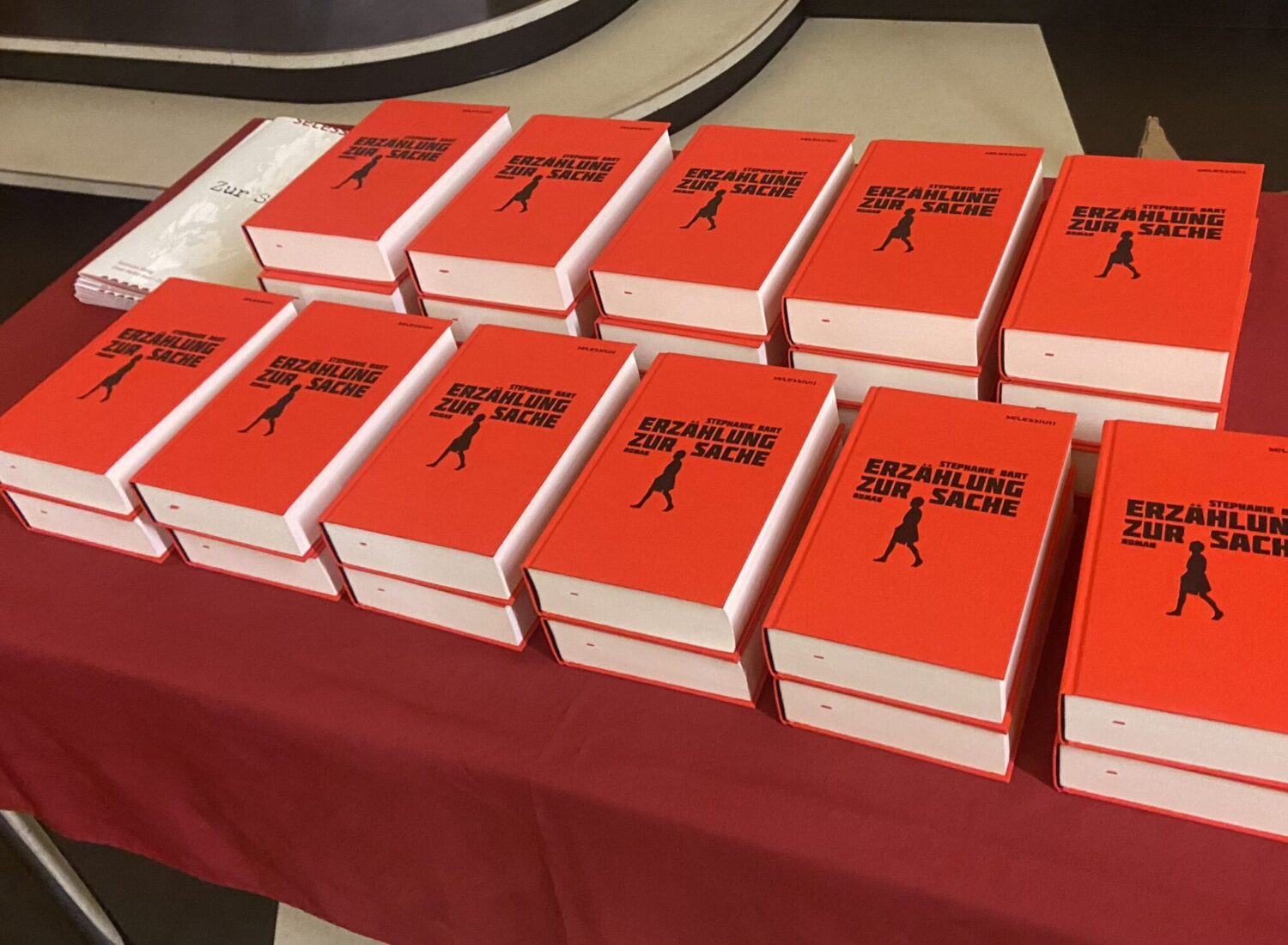
The award-winning author Stephanie Bart, recognised for her book “German Champion” (2014), is releasing her third book, “Narrative on the Matter”.
The plot of the book centres on the conflict between social forces and individual resistance, focusing on Gudrun Ensslin, a founding member of the RAF (Red Army Faction). It is an in-depth engagement with the turbulent, terror-marked events of those times. The story begins in May 1972 with a bombing at the US Army headquarters in Heidelberg and follows Ensslin during her five and a half years of imprisonment until her death in Stammheim Prison in 1977. Stephanie Bart sheds light on the era of RAF terrorism, a period in the history of the Federal Republic of Germany that rocked the very foundations of the rule of law. The book offers a comprehensive insight into Gudrun Ensslin’s mindset, her personality, and her significance for the RAF.
According to the author, the figure of Gudrun Ensslin has previously been neglected. She therefore felt it was important to take up this perspective and allow Ensslin to speak for herself. Bart succeeds in reproducing this tone of resistance by weaving together original texts such as letters, statements, and academic writings. However, in stark contrast to the internal perspective of the novel and the sources of information, the content consistently shifts away from Ensslin’s personal dimension. Readers learn little about her life, background, private matters, or the steps leading to her radicalisation. As a result, no deeper connection is formed between readers and the person of Gudrun.
While working on the book, Stephanie Bart worked closely with the jurist Prof. Dr. Peter Raue. He specialises in copyright and art law and is actively engaged in the arts and cultural scene. Raue reviewed the novel for accuracy and checked the content for copyright infringements. At a panel discussion for the book’s launch, Raue stated: “I couldn’t imagine that what was written had actually happened. But the grim truth is: these things did happen.” The book is a harrowing narrative of reality—both of the acts committed by RAF terrorists and of the Federal Republic of Germany, whose very legal foundations were shaken. “The book describes things that one would not believe possible in a state governed by the rule of law,” said Raue, referring to the depiction of judicial proceedings.
“The parallels are simply plain to see”
The global student movement of 1968 is regarded as one of the triggers for the phase of RAF terrorism, a spark of uprising scarcely confined to any single locality. Demonstrations and protests for peace and against the capitalist world order spread and escalated politically.
“Today it’s the same—the people are protesting and rising up in masses in various places all around the globe,” says Stephanie Bart. When grappling with the events of RAF terrorism from the 1970s through to the 1990s, reference to current affairs is inevitable. According to information from the NDR and WDR, at present, 20 far-left extremists are underground. This number hasn’t been as high since the RAF era. Furthermore, the head of the CSU parliamentary group, Alexander Dobrindt, has repeatedly labelled the climate activists of the “Last Generation” protest group as the “Climate RAF”. So, what parallels can actually be drawn?
“The parallels are simply plain to see. On an economic level, for one: we move from one financial crisis to the next. Then there’s the ecosystem, which is collapsing. When such things occur, it is absolutely inevitable that social contradictions become more acute. The crisis is a manifestation of this, and then people take to the streets,” states the author Stephanie Bart. Specifically regarding the actions of the “Last Generation”, Bart explains that “environmental activists, who openly practise non-violent resistance, are being criminalised. They are imprisoned and beaten.” It should be clear that a strong distinction must be made between activism and terrorism.
A demanding engagement with the events of this politically highly charged era, and an invitation to consider things from Gudrun Ensslin’s perspective. With her novel, Stephanie Bart wants to give readers a tool. “I’d be delighted if those who read the book were moved to become active themselves and to continue educating themselves,” she explains.