“We’re still waiting for a response from Al Pacino!” | Director Tim Dünschede on “Limbo”
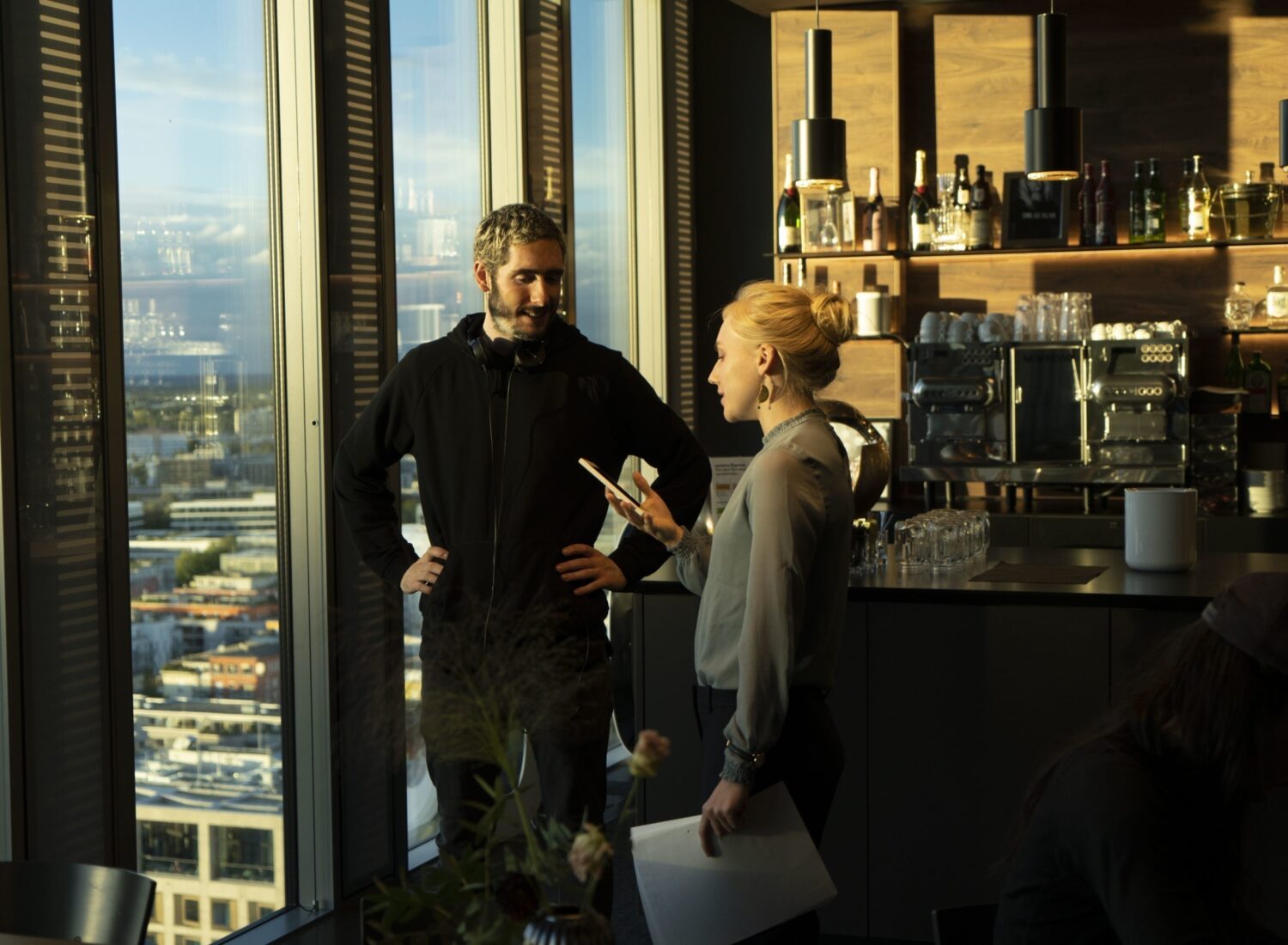
“Three lives. 90 minutes. One take” is what it says on the film poster. Young filmmaker Tim Dünschede, 36, managed his university graduation film entirely without cuts. The thriller “Limbo” tells in real time the story of three characters whose paths cross. Then, by chance, a furious showdown erupts in a boxing ring.
After its premiere at the Munich Film Festival, there followed an invitation to the prestigious Austin Film Festival. In addition to nominations for First Steps and the Michael Ballhaus Prize, “Limbo” was awarded the VGF Young Producer Prize.
Mr Dünschede, you thank Al Pacino in the credits. Has he got back to you yet?
We’re still waiting for a response from Al Pacino! (Laughs) At festivals, people have been very eager to know how this dedication came about. The reason is that my screenwriter Anil Kizilbuga and I were largely inspired by “Donnie Brasco” for the character of the small-time crook Ozzy. We even put a photo of Pacino up on our office wall for inspiration.
However, there’s no thank-you to Sebastian Schipper, whose “Victoria” was surely also an inspiration for a film without cuts…
That’s right, Sebastian Schipper certainly would have deserved that. After all, it was “Victoria” that gave us the idea for our project. But in the midst of all the madness, we simply forgot about a thank-you. We had so little time that we didn’t even get in touch to ask him for advice.
Those who are late are punished by the originality tribunal: Does it annoy you not to be the first whose film is made without

cuts?
Dünschede: Not at all, just before us Dani Levy presented a “Tatort” without cuts. And “Russian Ark” by Sokurov was made twenty years ago. Just because there are already westerns doesn’t mean I can’t keep making westerns. What we mainly wanted was the adventure of trying something we could actually fail at – and film school provided a safe framework to do that.
Do you have to be a bit nerdy to take on such a project?
I wouldn’t call it nerdy. Ideally, you should know your craft, because you really have to rely on it. This method doesn’t allow you to repeat scenes or try out different set-ups. You need to discuss everything with the team as thoroughly as possible beforehand, so that after the starting signal everyone knows where to go.
“When one goes down, the other goes to the corner!” says the referee in the film at one point. Was that your direction, too, when things threatened to go wrong?
Our motto was: “There are no mishaps! We keep going no matter what! No stopping!” The actors only really understood what that meant during the run-through. At the beginning, Elisa Schlott gets into the lift – we had prepared that sequence meticulously. But, by chance, the second lift arrived. As Elisa set off, the cameraman whispered, “Wrong lift!” That sort of thing obviously unsettles an actor, and Elisa couldn’t get the thought “I’ve messed it up” out of her head after that run-through. We had to overcome this fear of failure. Even when there was a mistake, we had to simply carry on.
With that opening scene, you could at least go back to square one, couldn’t you?
Dünschede: Unfortunately not, because of the light. The film begins at blue hour — if we’d started late, it would have been too dark on the street. Everything was so precisely planned that we absolutely could not stop. Filming started around 7.30pm, and 90 minutes later we had the film in the can.
How many run-throughs did you do before the final take?
There was a main rehearsal, where for the very first time we saw the entire “film”. After that, we discussed together which things still needed changing. Then came the dress rehearsal with a handful of key extras. Then we rolled. We couldn’t use the first take because there were still some problems with the set-up – that was the ‘hot’ rehearsal, so to speak. Then everyone knew it had to be the second take.
Without giving away any spoilers, what sort of mishaps did you encounter?
There’s a knock on the camera when Tilman Strauss forgot to hold the door open long enough for the camera to get through. And during the drive in the convertible, there were a few inadvertent changes to the dialogue. As a result, our cue words for the cameraman were missing, and the camera pans from the back seat didn’t go quite as planned anymore.
How do the actors know exactly which path to take? Did you use laser pointers to orient them?
No, we didn’t use either laser pointers or markings. Since all our actors actually have a lot of theatre experience, they simply have that physical memory – and that worked really well. If an actor took three steps too many, in a pinch the cameraman could compensate.
How do you organise the logistics for such a project?
The logistics get pretty complex when you’re changing locations and doing that with a car ride, too. When we were writing the script, it seemed very simple; putting it into practice was another matter. Even leaving aside the risk with the weather, a drive down Munich’s Leopoldstraße in normal traffic is a bit of an adventure. During the dress rehearsal, we had a constant wave of red lights, so the drive took twice as long. For those cases we had extra dialogue prepared as Plan B.
Speaking of Plan B: With “1917” apparently there were a few tricks in places. With a perfect cut, you can get away with it unnoticed. Is “Limbo” really and truly filmed in just one single take, without cheating?
We didn’t cheat – “Limbo” was made in a single take! My professor at film school said: “Be smart. Build in hidden cut opportunities, even if you don’t end up needing them.” Up until just before the shoot, we considered it, but then decided against. Because if such hidden cut points exist, people immediately suspect there have been cuts. We just put all our chips on one card and took a big gamble.
How much did you have to gamble to get Martin Semmelrogge on board with the project?
That happened quite normally through his agent. We sent him the first version of the script, then we met up and got on well. That’s how Martin Semmelrogge joined. Although he did slightly underestimate the two shooting days, because there were actually quite a few rehearsals as well. In fact, he was the one who made the most time available in the end.
From 20 February in cinemas

Photo credit: Nordpolaris