
“The Search for Help is a Universal Story.” Interview with Gus van Sant
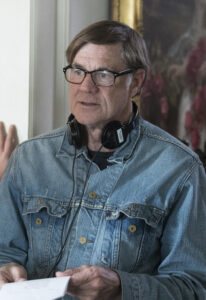
With his coming-of-age drama ‘My Private Idaho’, he created a cult film, and for ‘Good Will Hunting’, he received an Oscar. After the unsuccessful remake of Psycho, Gus Van Sant shone together with Sean Connery in ‘Finding Forrester’. For the poetically provocative school massacre drama ‘Elephant’, he received the Palme d’Or in Cannes. Following the Kurt Cobain biopic ‘Last Days’, he told the life story of Harvey Milk in ‘Milk’, the first openly gay politician in America, who was elected mayor of San Francisco in 1977 and shortly afterwards fell victim to an assassination attempt.
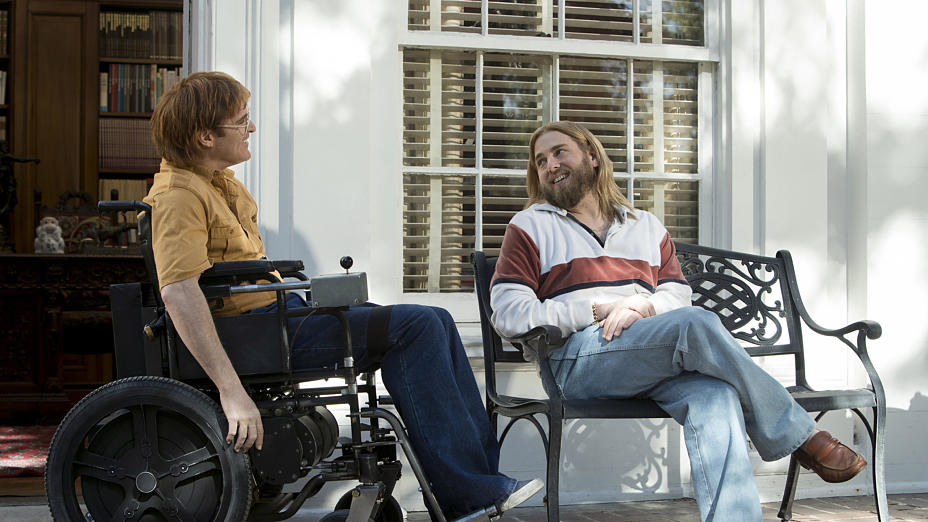
Now he presents, with ‘Don’t Worry, He Won’t Get Far on Foot’, the biographical portrait of cartoonist John Callahan. [030] staff member Dieter Oßwald met the director.
Mr van Sant, after the Berlinale premiere you were sat at a meal next to Wim Wenders. What do people talk about on such occasions?
Van Sant: Wim and I mostly talked about cameras and how we use them. We also chatted about paintings, since we both paint, and debated which colours are best. Politics wasn’t an issue for us, nor was football. (Laughs)
How do you remember John Callahan?
Van Sant: I knew John from the 80s in Portland. His cartoons appeared at the time in our alternative weekly paper, the ‘Willamette Week’, among others. I had just started filming ‘Drugstore Cowboy’ back then. So we were two artist types each trying to forge a career – though he did make a name for himself much faster than I did. John was a well-known figure in town. You’d always see him zooming down the rain-soaked streets in his wheelchair, his long red hair streaming behind him in the wind.
Some say the part of disabled John Callahan should have been played by a disabled person. Is that political correctness gone mad?
Van Sant: If we had found a good actor with this disability, that would have been fantastic. But I didn’t come across anyone. It’s really the same as with gay characters. Should they only be played by homosexual actors? I hardly think so! What matters in the end is that the actor suits the part.
How well would Robin Williams have suited the part, as was originally planned?
Van Sant: John Callahan felt it was a huge honour to be portrayed by Robin Williams, as Williams is one of the most famous actors out there. It was therefore all the more agonising for John that the project kept stalling and never got off the ground. He once joked: ‘We’ll all be dead before this film gets made’ – which, sadly in his case, turned out to be true.
As with ‘Milk’, with this biography you only show a section of the hero’s life. How do you choose which part?
Van Sant: There are biographies that depict an entire life. For me, it’s more exciting to focus on the defining chapters. Even ‘Lawrence of Arabia’ doesn’t tell his full life story, just the key aspects. With ‘Milk’, it was Harvey’s campaign for City Supervisor in San Francisco. With ‘Don’t Worry’, it was the major accident that left John wheelchair-bound while also freeing him from his alcoholism. For me, this – the fifth chapter of the autobiography – is the most important section of his life.
What significance does this theme of addiction have for you?
Van Sant: A character seeking help and receiving support provides a truly universal story. I immediately responded to that. And if that happens to me, I assume it will be similar for many others. Overcoming addiction here stands as a metaphor for many other cases.
Was it always clear from the outset that you’d tell the story in a semi-documentary style with 16mm film?
Van Sant: This is a concept we already wanted to use for ‘Milk’, but Universal didn’t want to make a film like that. So I was all the more thrilled to be able to realise this style now, and thanks to digital technology, it’s much easier to do so. We filmed with an Arri Alexa.
With Amazon, Netflix and co, is financing such film projects easier? Do directors like you now enjoy complete freedom?
Van Sant: Regarding Amazon, I can confirm that. They were very interested in this project, but that doesn’t mean they just dump a pile of money on your doorstep and say, ‘Do what you want with it!’ There were always creative discussions and suggestions, which were indeed quite good.
Were there moments when Joaquin Phoenix reminded you of his late brother River, with whom you once filmed ‘My Private Idaho’?
Van Sant: Joaquin reminds me of River in the way he passionately reacts to the unexpected. He too finds it thrilling when things go wrong, or he spontaneously makes something up. It makes things come alive. They never acted together and so don’t know each other’s technique. Yet they’re very similar in that approach, and in their dedication to a project.
In one scene, a dialogue contrasts art and craft. Does this apply to your work: do you make one film for a studio and the next for yourself?
Van Sant: I certainly made ‘Finding Forrester’ for the studio, and ‘Gerry’, ‘Elephant’ and ‘Last Days’ for myself. But it’s not that simple; usually it’s a mix of both. ‘To Die For’, for example, was a dark comedy, but Sony couldn’t do much with it because they didn’t know how to market it.

Did you foresee the success of ‘Good Will Hunting’?
Van Sant: With ‘Good Will Hunting’ I mainly wanted to find out if I could make a film with a positive character. In ‘Mala Noche’, ‘My Private Idaho’, and ‘Drugstore Cowboy’, it was always anti-heroes at the centre. So I was quite hesitant after reading the script for ‘Good Will Hunting’. I didn’t know if I could manage this positive character Will Hunting – or if I could only handle negative characters.
What was your relationship with Robin Williams like?
Van Sant: I knew Robin because he was meant to play Harvey Milk in Oliver Stone’s film adaptation. Stone dropped out and Warner brought me in to replace him. Eventually I got fired, and then Robin also dropped out. From that point on we got along well and he was very enthusiastic about the script for ‘Good Will Hunting’.
From Oscars to Palmes d’Or – how do you experience fame and success?
Van Sant: As a director, I’ve never reached the heights of a Steven Spielberg or a George Lucas. However, my work has given me a certain reputation. At the start, it’s tricky adjusting to the new success within your artistic circle. You buy a house because suddenly you’ve got the money and want to live there with friends – until you realise it’s not all it’s cracked up to be.
Your imagery and sound design are hypnotic – have you ever tried to reach your audience’s subconscious with subliminal methods?
Van Sant: A long time ago, I actually read a script about that topic. But I don’t work with subliminal methods to send subconscious messages. In the music, we might use elements that create strange effects, but none of that is intentional. I used subliminal methods in just one film – but I’m not going to say which one, of course.
Can you at least give us a little hint?
Van Sant: That was in one of my videos, not in a feature film.
‘Don’t Worry, He Won’t Get Far on Foot’ has been showing in German cinemas since 16 August.