
“Karl Lagerfeld is also outstanding as an actor” Interview with Julie Delpy

She was born in Paris to a pair of actor parents and was already sharing the stage with them at five years old. At 14, Julie Delpy appeared in Jean-Luc Godard’s “Detective”, and was later cast by directors such as Leos Carax (Mauvais Sang), Volker Schlöndorff (Homo Faber) and Jim Jarmusch (Broken Flowers). With Richard Linklater, Delpy made the romantic stories “Before Sunrise” and “Before Sunset”—her own directorial work “2 Days in Paris” is in a similar vein. Her new comedy “Lolo – Three’s a Crowd” now tells the story of a single mother tormented by her adult son. [030]’s Dieter Oßwald spoke with the director, co-writer and lead actress.
Madame Delpy, with over 800,000 viewers on its opening weekend in your home country, this is your most successful film to date. Why do you think that is?
Delpy: That might be because my previous comedies were bilingual and partly had subtitles. Outside Paris, that doesn’t always go down so well with audiences. On top of that, the film seems to strike a chord especially with women—and as we know, it’s women who decide what to watch at the cinema.
Do you also see the film as a warning to your six-year-old son for when he grows up?
Delpy: To be honest, I’m not worried that my son will ever become such a nasty tyrant as the character Lolo in our film—I’d have certainly spotted any such signs already as his mother. My son is the complete opposite of a selfish person.
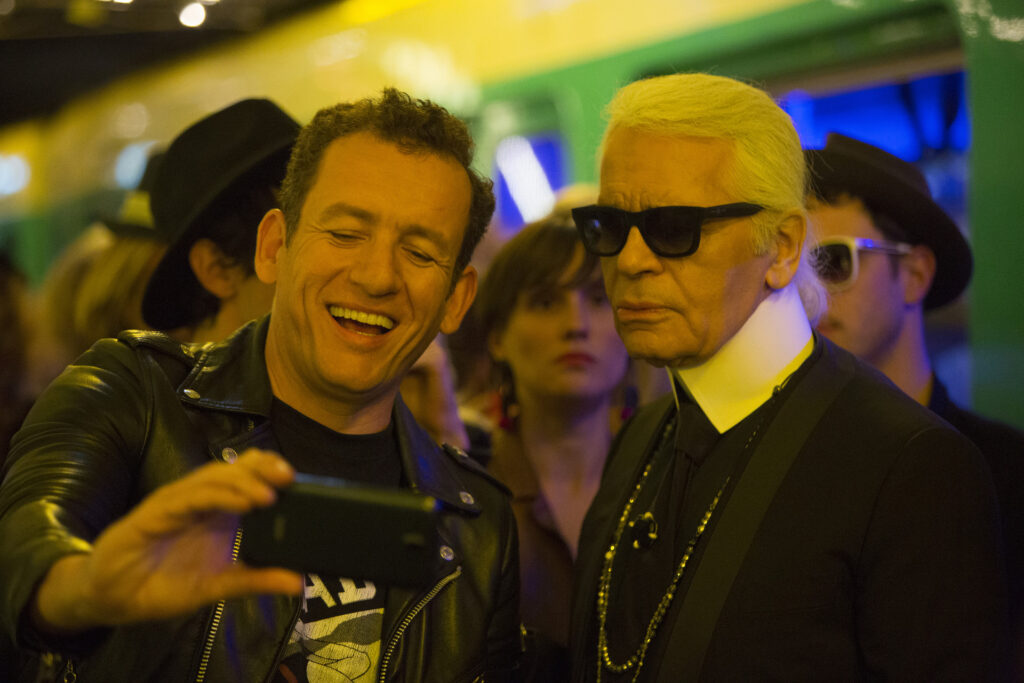
Your son’s father is German, you’ve already cast Daniel Brühl in your films and now Karl Lagerfeld—is there a special fondness for Germans?
Delpy: I’ve met wonderful people in Germany, and I also have fond memories of working with Volker Schlöndorff and Daniel Brühl. With Karl Lagerfeld, though, it wasn’t so much about his background—I actually wrote this part for him because he’s simply the ultimate icon in the world of fashion.
Lagerfeld wouldn’t automatically spring to mind for a comedy, where he’s almost parodying himself. How did you convince him?
Delpy: Karl’s a very smart guy with loads of humour. I’d quite adamantly deny that the film is making fun of him, though. The real butt of the joke is Dany Boon’s character, who behaves absurdly in Lagerfeld’s presence—I’m sure these sorts of situations are quite familiar to Lagerfeld, who’s constantly mobbed by selfie-hunters.
How do you direct someone like Lagerfeld?
Delpy: Giving direction wasn’t really the problem; Karl was initially rather anxious about going into this Underground station. Only after I explained that it would be closed to the public and only extras would be present was he willing to do it. To me, Lagerfeld turned out to be a fantastic actor—he could definitely take up a second career in that profession.
You’re often called the French cousin of Woody Allen—are you still able to stand this comparison?
Delpy: I take that as a tremendous compliment—Woody Allen is, after all, the most creative and prolific talent in film comedy. I’d be delighted to be even half as good as he is. And I wish, following his example, I too could make a film every year—but unfortunately, nobody will give me the money! (Laughs)
At the last Cannes Festival, there was again debate over why so few women are behind the director’s chair. What’s your response to that?
Delpy: In my experience, women are simply given less trust when it comes to directing. Things have improved a bit in France, but in America it’s still a real problem. When a man goes off filming for six months, his wife and kids usually go with him. Do you think it would be the same the other way around? What man would give up his job to accompany his wife? As a mother, I’m constantly faced with the dilemma of choosing between my child and my career. And after being away on a shoot for four months, I get funny looks at the school gates. Our world isn’t fair to women—and this is in Europe, where we’re not treated like slaves as we are in some other countries.
How strict are you on set?
Delpy: I know too many directors who gave up too soon. I’d rather be strict during filming to get a good result. If the film turns out well, the whole crew will forgive you for being tough. On the other hand, nobody likes a bad film just because the shoot was a pleasant experience.

Some of the dialogue is fairly risqué—do you draw a line on how far you’ll go?
Delpy: I try not to censor myself when writing. I like to go right up to the edge—that’s where the fun lies for me. After all, the heroines should also enjoy their lines. I grew up with satirical magazines like “Charlie Hebdo” and was already reading adult comics at six years old. They were rude but clever and witty too—and never vulgar. My writing style is also clear and direct, without ever becoming crude. We’re living in times when we’re increasingly bound by political correctness. But that doesn’t make humanity any better.
Is there a limit to humour? Would you make jokes about Islam?
Delpy: I think humour does have limits today, sadly, because the world isn’t as free as it once was. Personally, I wouldn’t make jokes about religion—for some people, it’s something they’d kill over.
Did you put poor Lolo in those old-fashioned ’80s underpants as a punishment for being such a baddie?
Delpy: Those colourful pants are totally on trend right now and all the rage at a big American fashion chain—I should really be getting paid for the advertising I’m giving these retro designs in my film! (Laughs)